Category: Overlanding

Any overlanding topic

  • The Tankwa Karoo National Park – Part 1: Langkloof

    The Tankwa Karoo National Park – Part 1: Langkloof

    This entry is part 1 of 1 in the series Tankwa

    The Tankwa Karoo National Park is a youngster compared to other South African parks. It was established around 1998, with an initial 270 km2; since then it has been expanded to 1463 km2. Before it was established, there was almost no preservation of Succulent Karoo in South Africa.

    It is one of the most arid areas in our country. A desert, if you will, with associated extreme temperatures. The heat will melt you during the summer, and the white walkers will find you during the winters – no wonder it is home to several scorpions and venomous snakes.

    What’s not to like?
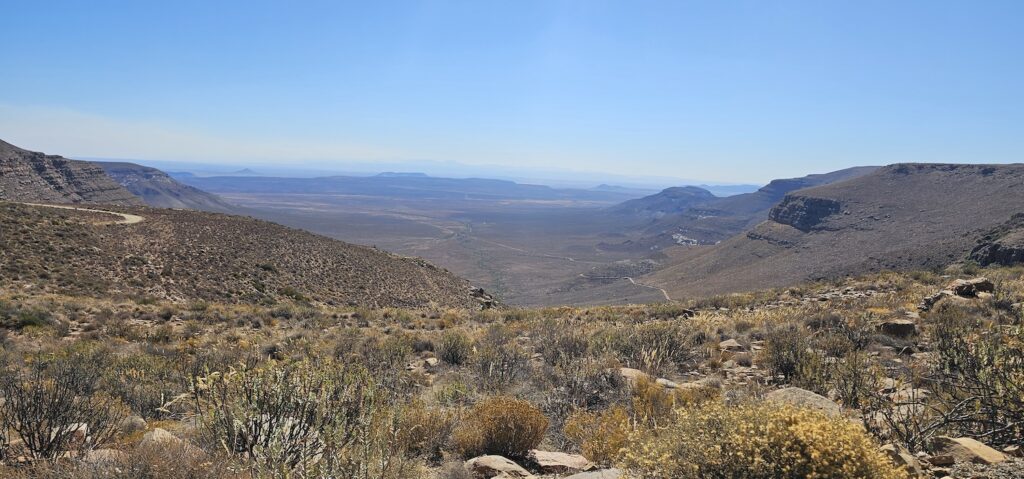
    When I travel, I like to experience things for the first time, to the extent that I will do as little research as possible for fear that it will spoil the experience for me. This works for us, due to my wife loving to plan everything in a fair amount of detail, which compensates for my laziness adventurous spirit.

    When we decided to stop at the Tankwa Karoo National Park, she made the bookings (as per usual). I did nothing (as per usual). She did mention that most campsites were booked (we left it late) but some with limited facilities were available; I responded that it’s perfect – the further away I’ll be away from civilisation the better. So, she went ahead and booked one night each at Langkloof and Biesjiesfontein.

    A day or two before departure, we started packing. I checked the weather at our various destinations, and I have no idea why I was surprised to find the maximums in the forties. It was, after all, the Karoo during December. Better pack a fan or two!

    From Gauteng, we travelled to Kimberley and had a two-day camp on a farm outside Britstown (at a great campsite – but I will cover that in a future post).

    From Britstown, we travelled west towards Williston, and then south to the Tankwa park.

    Do I need a 4×4 vehicle for this trip? There are sections in Tankwa where you will absolutely need 4×4. Other parts will be accessible with a 2×4 or even a normal sedan, but at your own peril. The shale rock on the road surface is a tyre slasher, so make sure you have at least one good spare. If you go in a regular vehicle, stay on the flat gravel and go in the dry season. Proper off-road tyres are more important than anything else on this trip.

    If you enter Tankwa from the Williston side, you are in for a nice surprise. Shortly after entering the park (just an unattended gate), you start descending the picturesque Ganaga pass. Built in 1896, this gravel road features 45 bends and 4 sharp hairpins along steep sections that are sometimes as narrow as an arrow. Be sure not to have a drink at the lodge just before the pass, because you need to be as dry as the surroundings for this one.
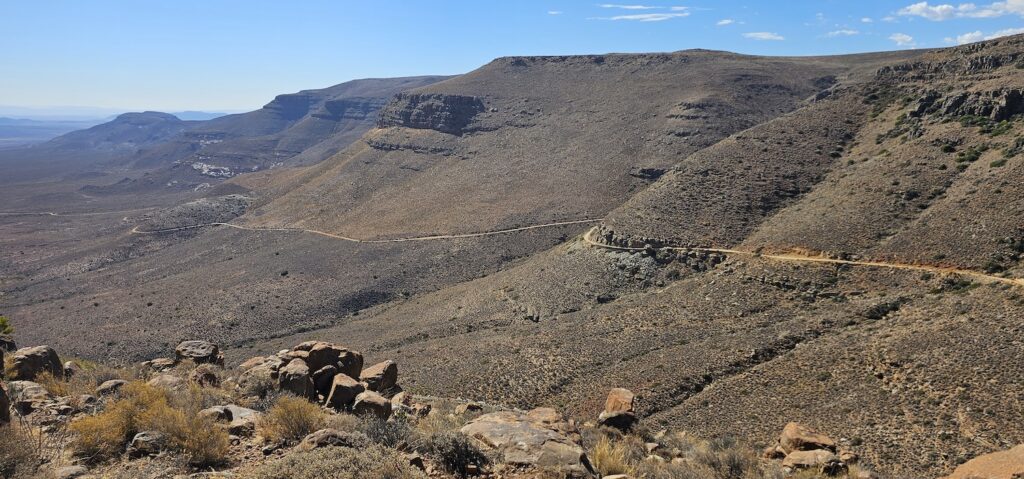
    During the descent, it became clear to me that the geology of the region is quite special, and I decided to read up on it when I get a chance.

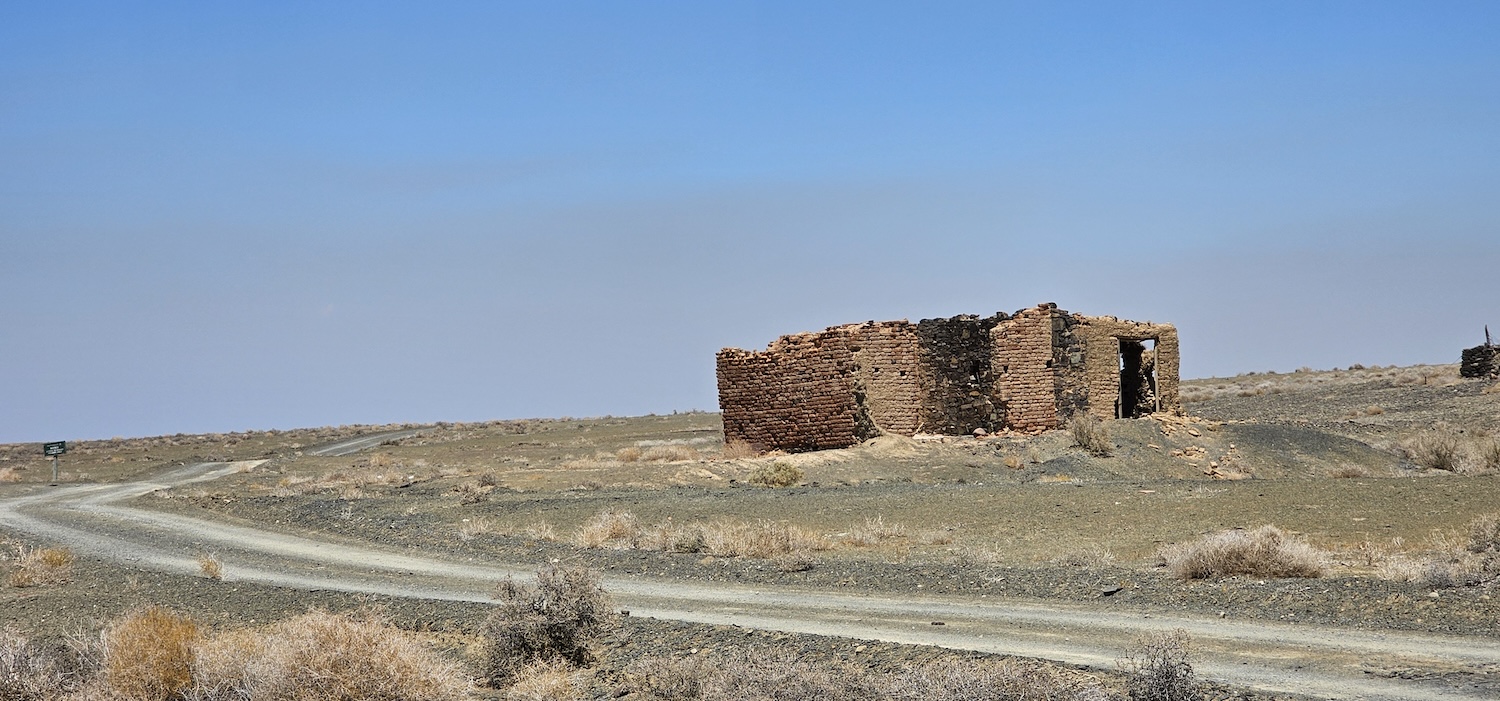
    Once we reached the bottom, we followed the GPS (no cell signal) to the administration block. This is where you get your permit for the park, and where you check-in for accommodation. In the waiting room, we found a few Europeans lounging around. To my delight there was a small book for sale (R100 or so) on the geology of the park. However, payment for the book uses a different payment terminal that wasn’t online, and they don’t accept cash. I tried to cut a cash deal with someone who worked there, but no go. As we left, the Europeans (Dutch, from what I could make out) were still sitting. With the heat rushing past as I opened the door, I realised that they were probably just enjoying the air-conditioned space inside.

    I couldn’t buy a book, but bear in mind that there is also nothing else for sale. There is no shop, no bottled water, no fuel, no tyres, nothing. It is extremely important to remember to fuel up at the last place that you can. If you don’t know where that is, just fill up everywhere you get a chance to. You don’t want to end up in a situation where you need to drive 100km+ to the nearest town!

    Our first night of camping was at the Langkloof campsite. The road to get there is mild, but rough towards the end. We engaged 4×4H but ground clearance will be more important. There is a dry river crossing, but I would guess that there would be water in the rainy season.
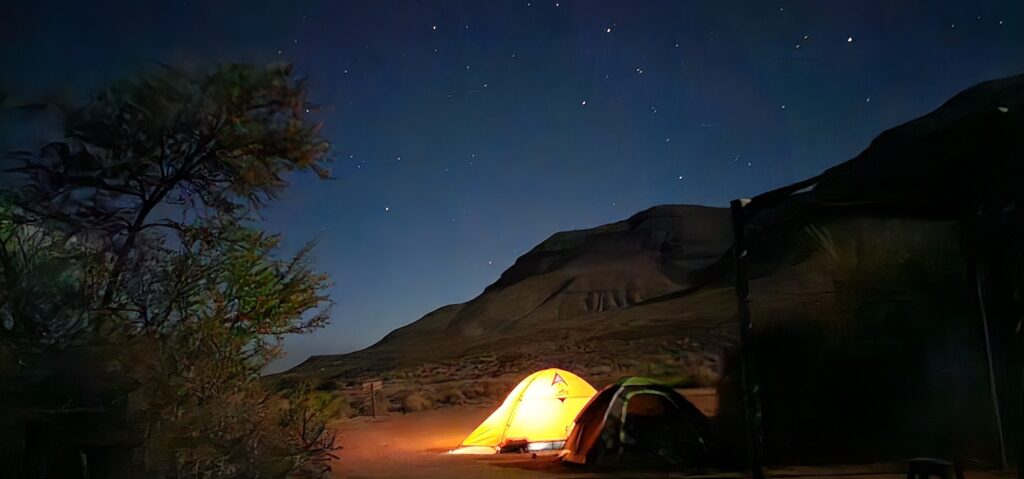
    The Langkloof campsite is nestled towards the bottom of the kloof. The scenery is spectacular and we saw quite a few antelope during the course of the day. There were some baboons; they kept their distance, but apply common sense and caution (as always) when camping.

    There are just two sites at Langkloof. There are full private ablutions with running (and hot!) water in really good condition, as well as a kitchen. Unfortunately there were a lot of flies during our stay – all rubbish remains at a section just outside camp and gets collected on (I guess) a not-so-regular basis.

    Luckily, despite the extreme heat a breeze was blowing. A very hot breeze, but a strong breeze – this helped a lot.

    Nothing in my current arsenal of photographic equipment could ever capture the night sky as we saw it there (or, actually, anywhere else on this trip), but I took a photo or two nevertheless.

    After a good nights rest, we had breakfast and departed.The next morning we departed with a little bit of trepidation; our next stop, Biesjiesfontein, had no luxuries. No electricity, no water, nothing.
  • Two important learnings from my first overlanding trip

    Two important learnings from my first overlanding trip

    Our recent trip to Namibia was by no means my first long trip, or my first camping trip … but I would say that it was my first overlanding trip.

    The Oxford dictionary is not very good at explaining overlanding, so I turned to an AI:

    Overlanding is a form of self-reliant adventure travel that involves exploring remote destinations in a vehicle, with the journey itself being the primary goal. It typically involves long-distance travel across varied terrain, often for extended periods, and relies on a self-sufficient approach to camping and lodging in the wilderness, far from traditional campgrounds. 

    When you overland, you need to carry enough stuff to survive, and I want to survive in relative comfort. Or perhaps I should phrase it differently: I am in this for the scenery, to see new things, experience different places. This requires a certain amount of sacrifice which I am willing to make, but I am not in it for the suffering.

    During the Namibia trip there were are a couple of items from my camping days that were really helpful – such as a small gas stove, a refrigerator, chairs, etc. For overlanding, I added a battery box for the first time. This allowed me to run the fridge 24/7, add a light to my canopy, charge devices and so on. I will write a post about that, at a later stage. It is the National Luna DC25 with a 100ah lithium battery.

    But in this post, I want to focus on two items that I didn’t have, or rather, that I would buy if I had to do it again: my tent and (lack of) a drawer system.

    Tent

    I have an Oztent (RV-3). This is famously known as the 30 second tent, as you can pitch it in 30 seconds.

    As with everything, the marketing version is not 100% true. I love my Oztent, and it’s going nowhere. It is a great, well-built tent and it is perfect for camping. However, if you relocate to a new location every day, it adds up.

    Due to the size of the tent (folded, it is 2m long) I carry it on the roofrack. To set it up, I need to do the following:

    • Untie the straps from the roofrack.
    • Lift it from the roofrack and set it on the ground.
    • Get it out of the bag.
    • Set it up (this is the part that takes 30 seconds).
    • Attach the poles.
    • Peg it to the ground.
    • Insert mattress, cushions, bedding.

    To take it down, the reverse process is followed. And I hate getting sleeping bags back into the tiny, small, little miniscule micro bags that they came with.

    The processes really are not that bad, but doing it day after day becomes tedious. It is totally do-able, but there are easier ways.

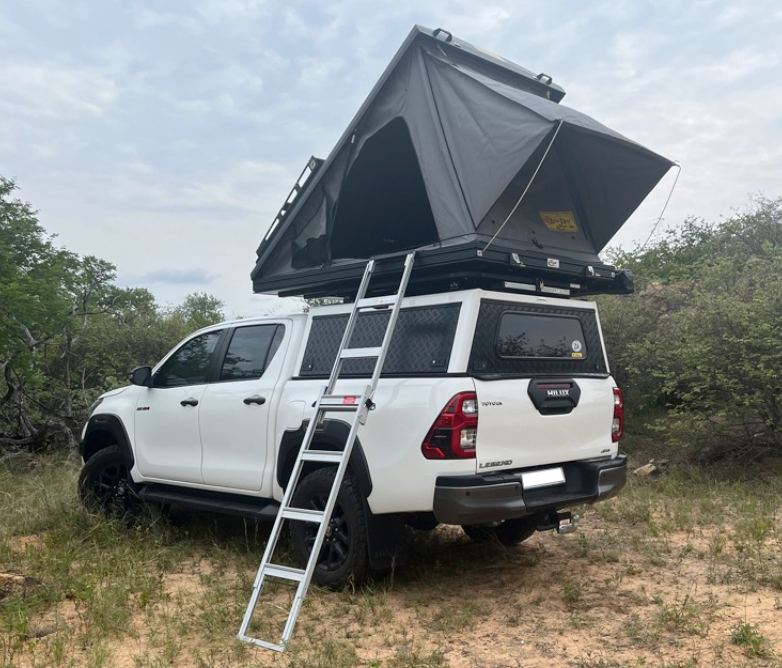
    If I had to do it again, I would rent or buy a hard-top type rooftop tent. The pic below is of an Eezi-awn blade, from their website.

    Credit: www.eezi-awn.com

    Some of the advantages are:

    • Extremely quick to set-up – just open it up, and lift. The gas struts open it automatically.
    • Just as easy to take down.
    • Can leave bedding inside the tent.
    • Can be safer from predators, but not without incident, and this is highly controversial.

    The last point has been debated many times. Personally, I want to visit Chobe next year, and I am not keen on a ground tent. I was very … ermmm … cautious at Purros on the Namibia trip – I am not keen on camping in the path of an elephant. The elevation may provide a false sense of security, but it does trick my mind, so I’m all for it.

    Some of the disadvantages are:

    • You have to climb a ladder.
    • There is less space.
    • You have to (preferably) park on even ground.
    • They require lots of storage space when not in use.
    • The hard-shell types are expensive.

    So, in a nutshell, if you need to move frequently, I think a roof-top tent is better. I am going to invest in a second-hand one, and will feedback after an upcoming camping trip during December / January.

    Drawer system

    Prior to the trip, I considered a drawer system of some sort, but decided that I can manage space a bit better on my own with crates, bags, etc.

    Now, it is true that a drawer system eats some of your space, but:

    • It keeps things organised.
    • It keeps things safe – no falling about inside the cab.
    • It makes things accessible – just slide out the drawer, no need to climb into the load bay.

    According to one of the Namibia posts, it looked like the devil was let loose in the back of the car, and I was not exaggerating. In fact, despite our best efforts, it looked like that almost all of the time.

    Eventually we gave up and just threw everything into the back. It was not much worse, but things were thrown around, some stuff got damaged, and so on.

    It was very disorganised (according to me), or absolutely chaotic (according to my wife). In fact, it looks like we will not do another trip without a drawer system of some sort (or, I will be left to my own devices!).

    I will give feedback here once both these boxes (roof-top tent and drawer system) have been ticked.

    Thanks for reading!