Our recent trip to Namibia was by no means my first long trip, or my first camping trip … but I would say that it was my first overlanding trip.
The Oxford dictionary is not very good at explaining overlanding, so I turned to an AI:
Overlanding is a form of self-reliant adventure travel that involves exploring remote destinations in a vehicle, with the journey itself being the primary goal. It typically involves long-distance travel across varied terrain, often for extended periods, and relies on a self-sufficient approach to camping and lodging in the wilderness, far from traditional campgrounds.
When you overland, you need to carry enough stuff to survive, and I want to survive in relative comfort. Or perhaps I should phrase it differently: I am in this for the scenery, to see new things, experience different places. This requires a certain amount of sacrifice which I am willing to make, but I am not in it for the suffering.
During the Namibia trip there were are a couple of items from my camping days that were really helpful – such as a small gas stove, a refrigerator, chairs, etc. For overlanding, I added a battery box for the first time. This allowed me to run the fridge 24/7, add a light to my canopy, charge devices and so on. I will write a post about that, at a later stage. It is the National Luna DC25 with a 100ah lithium battery.
But in this post, I want to focus on two items that I didn’t have, or rather, that I would buy if I had to do it again: my tent and (lack of) a drawer system.
Tent
I have an Oztent (RV-3). This is famously known as the 30 second tent, as you can pitch it in 30 seconds.
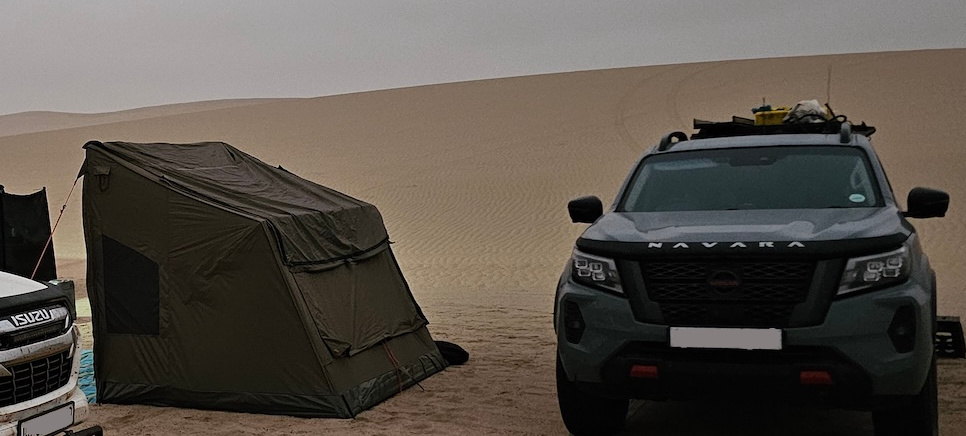
As with everything, the marketing version is not 100% true. I love my Oztent, and it’s going nowhere. It is a great, well-built tent and it is perfect for camping. However, if you relocate to a new location every day, it adds up.
Due to the size of the tent (folded, it is 2m long) I carry it on the roofrack. To set it up, I need to do the following:
- Untie the straps from the roofrack.
- Lift it from the roofrack and set it on the ground.
- Get it out of the bag.
- Set it up (this is the part that takes 30 seconds).
- Attach the poles.
- Peg it to the ground.
- Insert mattress, cushions, bedding.
To take it down, the reverse process is followed. And I hate getting sleeping bags back into the tiny, small, little miniscule micro bags that they came with.
The processes really are not that bad, but doing it day after day becomes tedious. It is totally do-able, but there are easier ways.
If I had to do it again, I would rent or buy a hard-top type rooftop tent. The pic below is of an Eezi-awn blade, from their website.
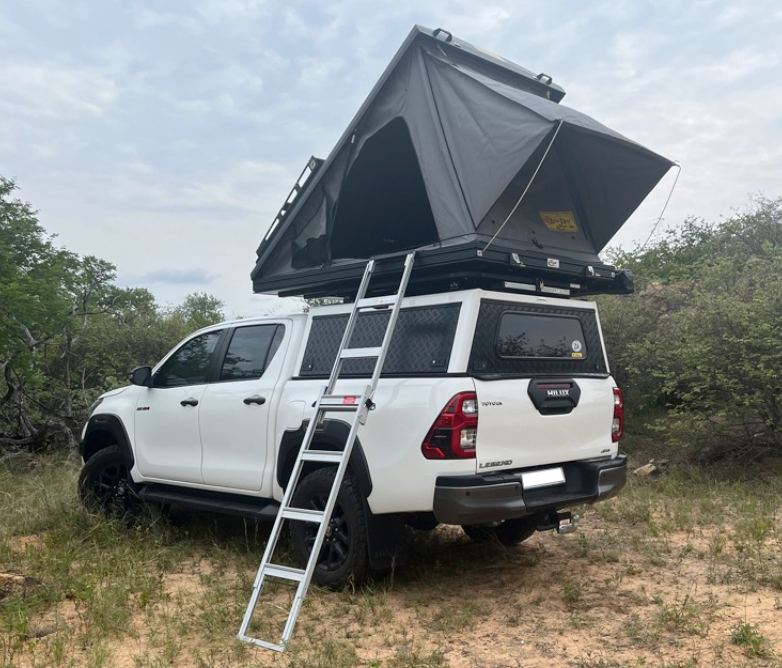
Credit: www.eezi-awn.com
Some of the advantages are:
- Extremely quick to set-up – just open it up, and lift. The gas struts open it automatically.
- Just as easy to take down.
- Can leave bedding inside the tent.
- Can be safer from predators, but not without incident, and this is highly controversial.
The last point has been debated many times. Personally, I want to visit Chobe next year, and I am not keen on a ground tent. I was very … ermmm … cautious at Purros on the Namibia trip – I am not keen on camping in the path of an elephant. The elevation may provide a false sense of security, but it does trick my mind, so I’m all for it.
Some of the disadvantages are:
- You have to climb a ladder.
- There is less space.
- You have to (preferably) park on even ground.
- They require lots of storage space when not in use.
- The hard-shell types are expensive.
So, in a nutshell, if you need to move frequently, I think a roof-top tent is better. I am going to invest in a second-hand one, and will feedback after an upcoming camping trip during December / January.
Drawer system
Prior to the trip, I considered a drawer system of some sort, but decided that I can manage space a bit better on my own with crates, bags, etc.
Now, it is true that a drawer system eats some of your space, but:
- It keeps things organised.
- It keeps things safe – no falling about inside the cab.
- It makes things accessible – just slide out the drawer, no need to climb into the load bay.
According to one of the Namibia posts, it looked like the devil was let loose in the back of the car, and I was not exaggerating. In fact, despite our best efforts, it looked like that almost all of the time.
Eventually we gave up and just threw everything into the back. It was not much worse, but things were thrown around, some stuff got damaged, and so on.
It was very disorganised (according to me), or absolutely chaotic (according to my wife). In fact, it looks like we will not do another trip without a drawer system of some sort (or, I will be left to my own devices!).
I will give feedback here once both these boxes (roof-top tent and drawer system) have been ticked.
Thanks for reading!